8.2
Viewer Rating
Combines user and critic ratings from four sources
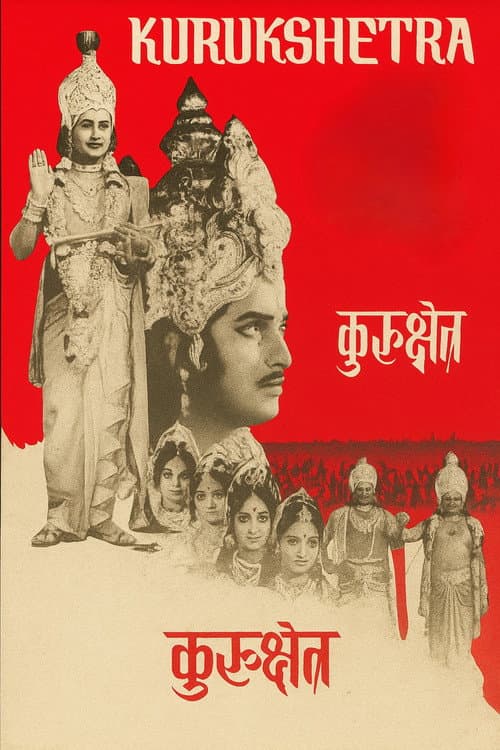
Kurukshetra (1945)
A combination of the epic story of the Mahabharata with contemporary social issues. It starts with a focus on a new social order, featuring three social workers, including Suvarnarekha, dedicated to eliminating idleness. The main narrative then unfolds by incorporating well-known mythological events like the Draupadi Swayamvar and the Sabha (Court) incident, progressing toward the Kurukshetra war. Throughout the film, these epic sequences are mixed with modern "social sequences" and philosophical lessons from the Bhagavad Gita in an attempt to address and provide solutions for national problems.
A combination of the epic story of the Mahabharata with contemporary social issues. It starts with a focus on a new social order, featuring three social workers, including Suvarnarekha, dedicated to eliminating idleness. The main narrative then unfolds by incorporating well-known mythological events like the Draupadi Swayamvar and the Sabha (Court) incident, progressing toward the Kurukshetra war. Throughout the film, these epic sequences are mixed with modern "social sequences" and philosophical lessons from the Bhagavad Gita in an attempt to address and provide solutions for national problems.
The film's narrative, rooted in the Mahabharata, champions the restoration of traditional moral order (dharma) and duty, emphasizing the consequences of unrighteousness and the necessity of righteous leadership, which aligns with conservative values.
The movie features a cast appropriate to its Indian mythological source material, without engaging in explicit race or gender swaps of roles. Its narrative frames traditional identities in a neutral or positive manner, consistent with an ancient epic, and does not incorporate explicit modern DEI critiques.
The film, titled after the epic battlefield of the Mahabharata, likely draws heavily from Hindu mythology and philosophy. It portrays Hindu deities, ethical dilemmas, and spiritual concepts with reverence, affirming the values and teachings embedded within the epic narrative.
The film "Kurukshetra," a mythological war epic based on the Mahabharata, does not feature any identifiable LGBTQ+ characters or themes. Consequently, there is no portrayal to evaluate within the scope of this framework.
The film "Kurukshetra" does not feature any identifiable transsexual characters or themes. Consequently, there is no portrayal of transsexual identity to evaluate within the narrative.
The movie does not contain any action or adventure elements.
The 1945 film "Kurukshetra" adapts characters from the Mahabharata epic. Research indicates that major characters, such as Arjuna, Krishna, and Draupadi, are portrayed with their historically and canonically established genders, with no instances of gender swapping.
The 1945 film "Kurukshetra" is an Indian production based on the Hindu epic Mahabharata. There is no historical or canonical evidence suggesting any character, originally established as Indian/South Asian, was portrayed by an actor of a different race in this specific adaptation.
Combines user and critic ratings from four sources