

7.0
Viewer Rating
Combines user and critic ratings from four sources
Crime, Drama, Romance • 1983 • 94 min • Adults (18+)
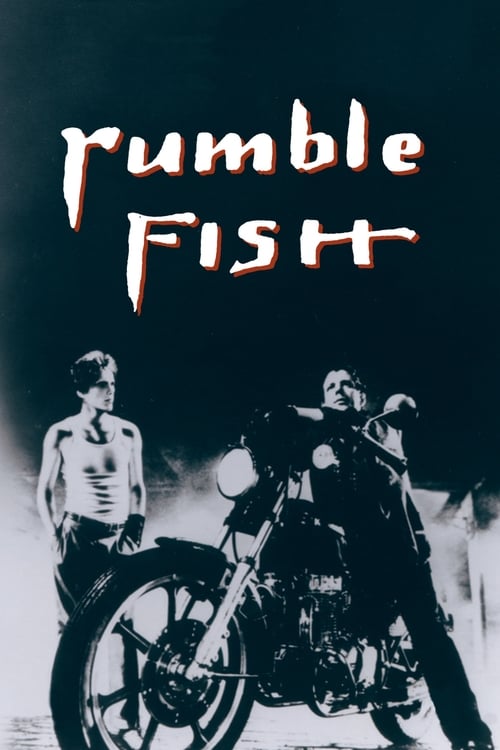
Rumble Fish follows Rusty James, a teenager drifting through a dead-end Oklahoma town, desperate to match the mythic reputation of his older brother. Francis Ford Coppola shot it in stark black-and-white, leaning hard into alienation and male identity. The Leans Traditional label reflects what the film centers on: white working-class masculinity, street loyalty, and the wreckage left by a broken home. That broken home, with an alcoholic father and an absent mother, reads as a critique of family collapse rather than a celebration of it. The film's concerns are personal and humanistic, with no political agenda driving the lens. Traditional in subject matter, sobering in outcome.
Matt Dillon • Mickey Rourke • Diane Lane
Rumble Fish follows Rusty James, a teenager drifting through a dead-end Oklahoma town, desperate to match the mythic reputation of his older brother. Francis Ford Coppola shot it in stark black-and-white, leaning hard into alienation and male identity. The Leans Traditional label reflects what the film centers on: white working-class masculinity, street loyalty, and the wreckage left by a broken home. That broken home, with an alcoholic father and an absent mother, reads as a critique of family collapse rather than a celebration of it. The film's concerns are personal and humanistic, with no political agenda driving the lens. Traditional in subject matter, sobering in outcome.
Matt Dillon • Mickey Rourke • Diane Lane
The film focuses on the individual, existential struggle for identity and escape from a predetermined, bleak future, rather than promoting a specific political ideology or solution. Its critiques are more social and humanistic than overtly political.
The movie features a predominantly white cast, reflecting its 1950s/60s working-class setting, without intentional DEI-driven casting or race/gender swaps. The narrative explores the personal struggles of young white males, focusing on themes of identity and disillusionment, and does not present a critical portrayal of traditional identities within a DEI framework.
The film portrays a deeply dysfunctional family unit with an absent mother, an alcoholic and neglectful father, and severely undermined parental authority. The narrative highlights the destructive consequences of a broken traditional family structure, serving as a strong critique of traditional norms.
Rumble Fish does not feature any identifiable LGBTQ+ characters or themes within its narrative. The story focuses on traditional masculinity, fraternal bonds, and heterosexual relationships in a 1980s street gang setting.
Rumble Fish does not feature any identifiable transgender characters or themes. The story is a coming-of-age drama centered on male protagonists, their family, and their experiences within a specific subculture, with no narrative elements or character arcs related to transsexual identity. The film's focus remains on themes of masculinity, alienation, and brotherhood.
The movie does not contain any action or adventure elements.
The film is an adaptation of S.E. Hinton's novel of the same name. All major and significant characters in the film retain the same gender as established in the original source material.
The film is an adaptation of S.E. Hinton's novel, where all major characters are depicted as white. The on-screen portrayals of these characters by the cast align with their established racial identities from the source material, with no instances of a character being depicted as a different race.
Not depicted in the film.
Combines user and critic ratings from four sources






