7.4
Viewer Rating
Combines user and critic ratings from four sources
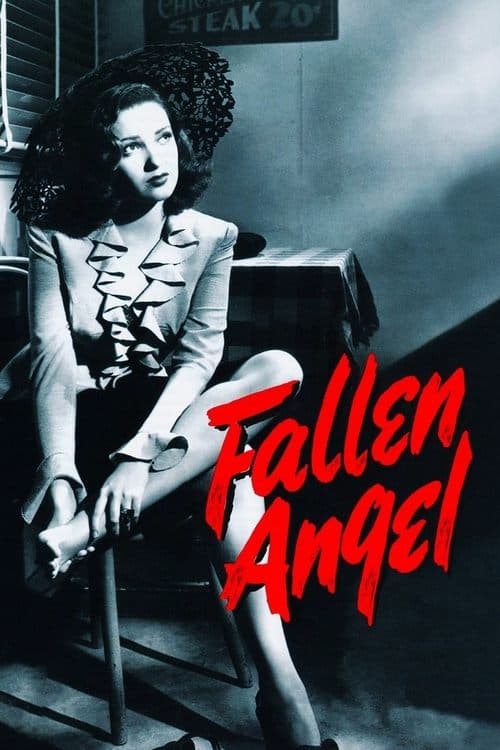
Fallen Angel (1945)
An unemployed drifter, Eric Stanton wanders into a small California town and begins hanging around the local diner. While Eric falls for the lovely waitress Stella, he also begins romancing a quiet and well-to-do woman named June Mills. Since Stella isn't interested in Eric unless he has money, the lovelorn guy comes up with a scheme to win her over, and it involves June. Before long, murder works its way into this passionate love triangle.
An unemployed drifter, Eric Stanton wanders into a small California town and begins hanging around the local diner. While Eric falls for the lovely waitress Stella, he also begins romancing a quiet and well-to-do woman named June Mills. Since Stella isn't interested in Eric unless he has money, the lovelorn guy comes up with a scheme to win her over, and it involves June. Before long, murder works its way into this passionate love triangle.
The film's core conflict revolves around individual moral choices, obsession, and deception within a crime narrative, which are largely apolitical themes. Its resolution emphasizes personal responsibility and a return to conventional stability, but this is presented as an individual's journey rather than an explicit promotion of a political ideology.
This 1945 film features a cast that is predominantly white, reflecting the common casting practices of its time, without any intentional race or gender swaps of traditional roles. The narrative focuses on its mystery and character drama, offering no explicit critique of traditional identities or incorporating specific DEI themes.
The film portrays Stella's Catholicism with respect and nuance, showing her faith as a genuine internal struggle for virtue. While her sisters' piety is depicted as rigid and judgmental, the narrative explores the complexities of human behavior within a religious context without condemning the faith itself.
Fallen Angel is a classic film noir centered on a heterosexual romance, a murder mystery, and moral ambiguity. The film does not feature any discernible LGBTQ+ characters or themes within its plot or character arcs, resulting in no portrayal to evaluate.
Fallen Angel (1945) is a film noir centered on a murder mystery and romantic entanglements. The movie does not feature any identifiable transsexual characters or explore themes related to gender identity. Therefore, its net impact on the portrayal of transsexual individuals is not applicable.
The movie does not contain any action or adventure elements.
The 1945 film "Fallen Angel" is an adaptation of Marty Holland's novel of the same name. A review of the source material and film's characters indicates no instances where a character's established gender from the novel was changed in the film adaptation.
The 1945 film "Fallen Angel" is an adaptation of a novel published in the same year. There is no evidence that any character, canonically established in the source material, was portrayed by an actor of a different race in the film.
Combines user and critic ratings from four sources